


Materials We Use
Our products are meticulously handcrafted by skilled artisans using locally sourced materials.


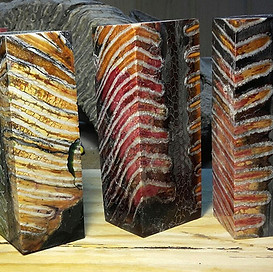
MAMMOTH TUSK
Many artisans and blacksmiths utilize mammoth tusks and teeth to embellish handles and sheaths, sourcing these materials locally along the riverbanks.
Since ancient times, people have learned to use mammoth bones and tusks as tools for everyday use, jewellery, and all kinds of crafts. And now, every year in the summer, with the melting of snow and permafrost ice in the north of our planet, people find tens of tons of remains of woolly mammoths, rhinos, sabretooth tigers, ancient bears, horses, wolves, and all kinds of animals of the ancient world. They discover the remains of gold and industrial development. Hunters and anglers, following the collapse of the coast, are engaged in the search for residents to feed their families because of unemployment. The quality of the material is different, including mammoth tusks. Unlike modern-day living elephants, the material of a mammoth's tusk contains unique Schrager lines (a drawing of a crosshatching) that are crossed at approximately 90 degrees at the external corners, whereas elephants have an entirely different degree. Many artifacts found in our Republic of Sakha still amaze the world with the quality of the preserved material in the permafrost. Nowadays, scientists around the world are trying to clone mammoths from the remains found in our Republic in large laboratories in America, Europe, and Asia.
Woolly Mammoths went extinct many thousands of years ago; according to some theories, they were victims of drastic climatic changes during the Ice Age. Mammoths existed from the Pliocene (5 million years ago) to the early Holocene (about 4,000 years ago). The animal had long, curved tusks, and the species that lived in the north had long hair. The tusks reached up to 4 meters, and the size of the mammoth reached almost 5 metres in height. Their weight ranged from 4 to 14 tons. This animal's robust skin was a tidbit for primitive people who lived in harsh conditions because of the cold and winds. Fatty, nutritious mammoth meat provided long-lasting, tasty meals for the entire family. Nowadays, scientists believe it was the cooperation of primitive people in hunting the mammoth that was the crucial factor in the evolution of the entire human civilization.

Mammoths became history during their lifetime, but for artists of ancient times, they were one of the most popular objects for drawing. Mammoths were painted on cave walls and rocks.
Although mammoths no longer live, we have a good idea about them. And all thanks to the fact that in the northern regions of Siberia, Alaska, and Canada, there is still a freezing climate. It enables the preservation of many mammoth remains, almost in their primordial state. Many of them remain almost completely intact.

Sourcing mammoth tasks


